

Putting humanity at the heart of welfare
In this blog, Jamie Hancock reflects on the enduring challenges that people face when navigating the welfare system, as highlighted by Demos’ Online Listening research in partnership with the Joseph Rowntree Foundation’s (JRF) Insight Infrastructure team. Over the last year and a half, we have analysed forum conversations spanning from 2010 to June of this year. This research has identified consistent concerns and problems in how people relate to the welfare state. Such experiences are starkly opposed to the vision of relational and liberated public services that Demos has called for. You can find the latest wave of our research here.
“I’m feeling sick from fear about this transition from Employment Support Allowance to Universal Credit. I’ve lost several hundred pounds compared to what I got with ESA” (Anonymous forum user, 2025).
This story comes from the latest wave of our Online listening research into the experiences of people facing financial hardship. As in too many of the cases we have documented, the welfare system comes across as inaccessible, inflexible, and inhumane. These stories make it clear: the UK’s welfare system does not work for the people that rely on it the most.
The Online Listening project gives us insights into people’s lived experiences of financial hardship through a large-scale analysis of forum conversations every few months. Throughout the project, we have heard consistently about recurring problems in how the welfare system treats those that depend on it. These include very poor communication from service providers, limited transparency about decision-making, frequent delays, and long waiting times. People consistently say that they are not treated with respect or allowed to access welfare with dignity. Instead, the system is perceived to be punitive and degrading. These experiences are starkly opposed to the vision of accessible, flexible, people-centred public services that Demos has called for. Another welfare system is possible – one which treats people with dignity and care. But this will only be possible by fundamentally changing how the welfare system relates to the people it is meant to serve.
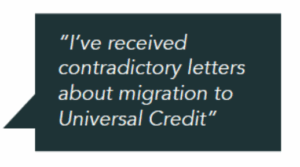

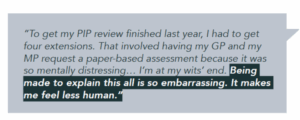
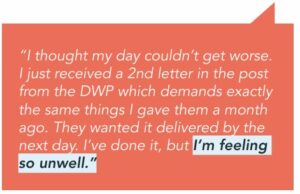
Through our regular waves of research and our conversations with the Grassroots Poverty Action Group – a group of people with lived experience of financial hardship convened by JRF which acts as an advisory group for this project – we have identified consistent challenges that benefit claimants face. People have described how the system places a heavy burden of administrative work on them and while offering minimal transparency or ease-of-use in return. They also say that interactions from the Department of Work and Pensions (DWP) are often negative experiences: important communications can be confusing and subject to delays, while staff are frequently alleged to be rude or unhelpful.
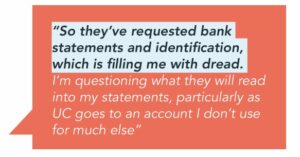
In one notable development we have picked up on this year, people reported a rise in reviews of their Universal Credit claims which involve sudden requests for four months of their bank data. Forum users say these reviews are poorly explained, invasive, and make them feel like suspects even if they are not aware of any wrongdoing. Overall, conversations conveyed a feeling of not being listened to by decision-makers or properly consulted by the government about policies that will affect them.
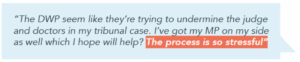
Our findings are especially concerning in light of recent policy developments which could further reduce transparency, accountability, and fairness in the welfare system. For example, the DWP has announced several initiatives to procure AI, machine learning, and automated decision making tools throughout the benefits system. These initiatives include algorithmically-assisted fraud detection tools and systems to inform Employment Support Allowance (ESA) decisions using claimants’ medical data. Meanwhile, the Public Authorities (Fraud, Error and Recovery) Bill – which is passing through Parliament – will give the DWP the power to request banking data directly from banks, rather than having to request it from benefits claimants directly.
Such initiatives have a history of poor outcomes for vulnerable people. For example, in 2024, it was revealed that an internal DWP assessment found that an AI fraud detection system it used featured significant bias according to age, disability, marital status and nationality. In another scandal, the government is considering whether to pay compensation to people who were forced into thousands of pounds of debt to the DWP for accidentally making minor errors when claiming Carer’s Allowance. As the DWP continues to try to automate the benefits system and adopt AI to identify potential fraud, there is a risk that the system will become more opaque and impersonal than it already is.
At Demos, we have called for public services to become more ‘relational’ in their ways of working. By this, we mean that services should allow people to build positive personal relationships with their public service providers, building up trust and allowing people to use public services with dignity. We have also called for ‘liberated’ public services: to give public service professionals more flexibility and autonomy, while making citizens and service users active partners in the co- production of the services they use, rather than passive recipients. When it comes to adopting AI and related technologies, we have argued that these tools should only be rolled out alongside organisational reforms which improve ordinary people’s experiences of services – not as a cost-cutting measure, silver bullet, or surveillance tool. Unfortunately, the stories we have uncovered through our research – together with the DWP’s current direction – demonstrate precisely how not to run a public service that supports society’s most vulnerable people.
It is possible to have a welfare system which treats people with dignity, compassion, and care. Achieving that vision will require fundamental changes in how the system relates to the people that depend on it: more humanity, not less.
This is the third blog of three to accompany the launch of our Wave 2 report: “It’s tough out there”. The first blog can be found here and the second is here. If you’d like any more information about this project, do get in touch with [email protected] or [email protected].